Portfolio & Work

  • Deer Tracks

    Deer Tracks by Lily Selthofner, watercolor and colored pencil on paper, 5″ x 7,” 2022.
  • Disco Ball Funeral

    Created April 2023

    This project was made possible through the production and technical support of the Movement Lab in the Milstien Center of Barnard College.

    Screened with live performance and installation as part of Performance Arts Course at the Undergraduate Arts Showcase in May 2023.

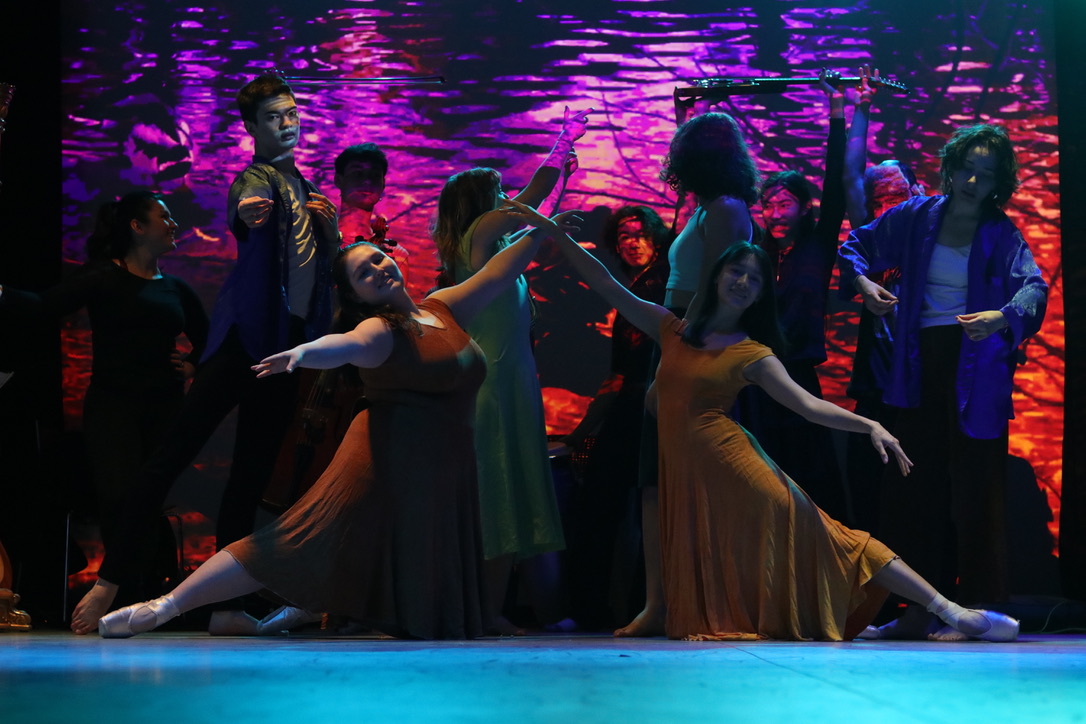
    Disco Ball Funeral is a 7.5 minute film about the death of a romanticized, personified Disco Ball. A murder mystery, the process of uncovering the truth about Disco Ball’s death is emotionally chaotic, like any good funeral. Since his burial was improper, this piece serves as the synchreses of many different memorials that honor his life through sculpture, sound, movement, and ritual. In his physical absence, the film does not dote on his shiny aesthetics. Instead, the meaning of his life is captured through memories of Disco Ball shared in interviews, video footage of his funeral, and photographic memories from his life, alongside interpretive dance and narration that avenges his demise.

    Disco Ball’s reflective and refractive nature, and his creative and connective reciprocity, guide the film’s thematic motifs that explore relationality. He is more than the sum of his audience of friends, through time-transcendent glimmers. Cliche filmmaking styles such as vlogging, public parodies, and collage are satirically employed to comment on humanity’s obsessive materiality and the cognitive dissonance of romantic idealism, particularly within patriarchal norms. Additionally, this piece is imbued with deeper meanings exploring loss, blame, insecurity, justice, closure, and memorialization through this emotionally charged mission to reckon with Disco Ball’s death, at the hands of male violence.

  • Catch Up

    Created April 2023. This project was made possible thanks to the Movement Lab in the Milstein Center of Barnard College.

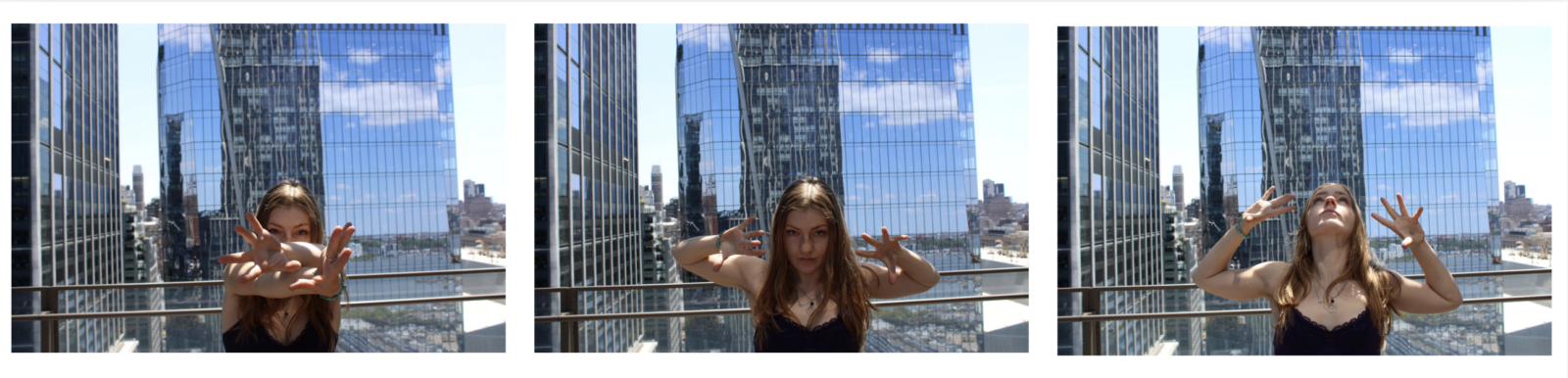
    This short video, Catch Up, is an exploration of synchresis — the juxtaposition of multimedia elements — in an audio ethnography that calls upon soundscape, voice, body, and memory. Here, hazy dance is mixed with montaged snippets of audio collected in Paris, France, such as voice journals and other site-specific field-recordings from the urban environment.

    The essay below brings this work into conversation with ideas outlined in the book Sound on Screen by Michel Chion, a French composer, film theorist, and scholar renowned for his pioneering work on the relationship between sound and image in cinema.

    Chion’s ‘image of language,’ and the meaning of language as places where the brain first goes, point towards a great chasm between the effable and ineffable, as shaped by our perception of it. The relationships between dancing, music, technology, improvisation, and ethnography are of particular interest – how the spatial, temporal, and emotional relationships between these happenings change the nature of the art. It is a synchresis happening on and offscreen, between senses, timelines, and physical locations, in spatiotemporal reimaginations.

    Dance is deeply ephemeral, and the kinesthetic empathy that intertwines performers and audiences is predominately somatic. Yet, the image of dance involves a translation of content’s meanings into choreographic form, in a similar way to language. I think dance has powerful potential as a language that is more fit for understanding ourselves and existence. The body can make spatial and visual occupations that are more fully engaging linguistic networks to live within, a physicality that can still ‘fill chambers’ like echoing words. Further, ‘the body’ itself is at once a gigantic eye, ear, and instrument, amongst other things, which allows ‘the body’ to uniquely swim in the aforementioned chasm separating language and the ineffable. These things come to mind as I think in conversation with Chion’s ideas of the ‘eye as more spatial, and ear as more temporal.’ The poetics of visual microrhythms, and the (irr)reversibility of image and sound, compels me to create at the intersections between technology and magic.


     Perhaps it is compelling to creatively explore how Chion’s ‘synchresis’ manifests between nuanced modes of being: What happens when we “rediscover” gustatorial, proprioceptive, vestibular, etc. senses in connective ways? Here I am compelled towards technology’s ‘recordability’ to bring to life the ‘extrasensory perceptions’ of the magician, toward exploring how infinite immersions, both nurtured and innate, that are synchresistic. What underlying truths can be revealed from synchresis? Which combinations of sensory inputs are seemingly forged from nothingness/randomness, which are uncannily juxtaposed, and which feel even more innate (and satisfying) than the original sound-image relationship itself? This conceptual grounding both emerges from and extends the multiplicities of realities that interweave through our perception.

    Technology can also supplant the original divide between mediums, instead of bringing them together supplementally. As Chion discusses regarding horror films — sometimes when sound and image give different information, the composite (reciprocity of added value) feeds a newness back onto itself. For example, when one records oneself dancing to music, it is most helpful to watch back the video silently, so that the flow of music doesn’t supplant itself onto, and thus obscure, the image of dance. I think of the predominance of silent dances and dance films in the postmodern era, so that sound doesn’t alter movement or perception, and ‘the body’s’ artistic merit can standalone.  Thus, to emulate the organic workings of perception and technology, Catch Up is a deliberate stimulation of senses through synchresis: where kinesthetic empathy, ethnographic memory, and linguistic form emerge from the blend of ‘the dancing image’ and atmospheric sounds. The temporal poetics of memory are enacted through the forms of fragmentation, repetition, fading, blurring, and restructuring of visual and audio, set to evoke the auric buzz of Paris.

    Chion, Michel. Audio-Vision: Sound on Screen. Translated by Claudia Gorbman, Columbia University Press, 1994.

  • Caution Wet Floor

    Caution Wet Floor

    Caution Wet Floor (2/23): Co-directed with Eva Thomas, Caution Wet Floor is a movement and visual arts study of revolutionary pathways, and cautionary signs. This filmic journey explores agency, boundary, and the murky depth of the industrial subconscious, wandering through underground tunnels. Within the uncanny industrial world of liminal spaces are basements and laundromats. The slip of paint on the human body, footprints, when dance creates its material artifact intentionally. The painting is a language and has been interpreted as a choreographic notation. It is an archaeology in time, with singing and soundscapes from the same basement, and grey timeless echoes, chasing. The story perpetually unfolds as the pathway revolutionizes itself — a chamber. Fear holds us back from inevitable transformations, all lines eventually reveal themselves as circles. Through movement, song, and painting, the piece questions our attachment to imagined security in pathways and beckons a surrender to the creative truths in winding sunless tunnels

    Questions from Deborah Hay’s choreographic inquiries in Using the Sky: A Dance

    https://lilyselthofner.com/climbing-lost/
    Climbing, Lost by Lily Selthofner — poetry used in sound

    On the sonic exploration of chambers in this hallway:

    I am walking through a long and windy hallway in the basement of my building, using my flip-flops as an attempt at echolocation (and time-keeping). The metronome of my steps reflects the tension in my toes, and the slope of this perpetually down-hill hallway. I can hear my memories from earlier in the day resonating in the too-hot fan, the smell of the trash shoot’s opening being pushed around. The tensions are apparent in my movement and in my perceptions of the sound itself. Likewise, exiting the liminal space, alone in the dark, implies entering the real-world, and I don’t know which I prefer. Unfortunately, the sounds I make in this hallway can probably be heard by people in the laundry room nearby (even though that space is also quite loud). My consciousness is external as I listen to myself from afar, trying to blend in with the resonances of the hallway.

    The sonic effect is irreducible to either objectivity or subjectivity – in that the sound effect describes “the sound milieu of a socio-cultural community, and the “internal soundscape” of every individual” (9). From here, I wonder exactly how conscious perceptions can also distort the physical signal, as the physical signal can distort perception  – especially in the technological infinity of modernity (8). It is difficult for me to conceptualize, as I already felt that the relationship between internal and external was likewise irreducible to either objectivity or subjectivity– for example, what is the true difference between saying a mantra aloud or just in one’s head? Do others’ perceptions of my saying something, through the external space, change the physical nature of the sound, by altering its meaning perhaps? Further, in a telepathic context, how do other conscious beings (animate, moving – everything from other humans to the objects in my room) affect the nature of sound that “I” emanate? Perhaps a cluttered mind and a cluttered room are issues of sound rather than/alongside sight… 

    I wonder how defining sound attributes with language, or even just the conscious awareness expressed through language, changes the nature of sound. Is sound self-defining, having autonomy and agency, or is sound only an aspect of such animacy? Is language the best way to share articulations about sound, and come to the same page? Would urban noise pollution be less physically and psychologically damaging if it was talked about differently? Or thought about differently? How has the nature of sound changed with the advent of technology – doing this work without ‘conscious input?’ At this moment I am seeing the importance of teaching how to listen. I am also wondering about how my relationship to movement can change how I listen. I just read a quote from Trisha Brown (postmodern dancer/choreographer who didn’t use music with her work until much later in her career) saying that because music inspired feeling and movement within her, she felt it was ‘cheating,’ or at least distracting, to her goal of exploring movement in a ‘pure’ way. While I agree, I also think that every inevitable movement is also an inevitable sound, and alters the way we perceive sound. This ties back to the pace of my flip flops reinforcing the state of listening that was co-created by my movement, the perception of sound, and the sound ‘itself.’ Perhaps the solution here is a focus on internal rhythms, and the infinite chamber of perception.

    Visual Art Component of Caution Wet Floor
  • Splash Again(st)

    Sometimes people feel like fish out of water.

    This short film and visual art piece are components of a performance art work exploring stillness, created for the Performance Art course at Columbia University.

    Created February 2023.

    Splash Again(st) Visual Art Component
    Process — Thoughts on Stillness